Between the Pages: Is Gwyneth Paltrow Wrong About Everything?

Timothy Caulfield seems like the type of person that you would want as your friend. Unless you are a colon cleansing, dream pursuing, celebrity adoring kind of person. Then he might come across as a bit of a “patronizing know-it-all jerk” (his words, not mine).

In his latest book Is Gwyneth Paltrow Wrong About Everything?, Caulfield looks at the messages spewed out by celebrity culture and how those messages stack up against scientific evidence. Spoiler alert: the answer to the book’s title question is an unequivocal yes.

Is Gwyneth Paltrow Wrong About Everything?: When Celebrity Culture and Science Clash. By Timothy Caulfield (Source)

The book starts by examining the vast array of health and beauty treatments inspired and endorsed by celebrities, including the Clean Cleanse made famous by Gwyneth Paltrow on her lifestyle website Goop. One of my favourite parts of the book is when Caulfield himself becomes a test subject and tries out the cleanses, spa treatments, and skin-care regimes that are supposed to make him healthier, slimmer and more beautiful. The results? He lost weight (but gained it back as soon as he started eating real food) and his skin was no better off after nine months of using high-end beauty products.  Continue reading
You are what you eat: new evidence shows that sea slugs carry algal gene

One of the most commonly touted attributes of science is that its ability to self-correct. New models and theories are constantly being generated based on experimental results but just as frequently, these new theories and ideas are challenged and sometimes, proven to be wrong by other scientists. Encouragingly, this type of academic rigor is not exclusively applied to high-impact research (recently examples include a deceptively simple method to create stem cell and a bacteria that uses arsenic to build its DNA) but also to the seemingly insignificant curiosities of life. The case of the green sea slug falls into this latter category.

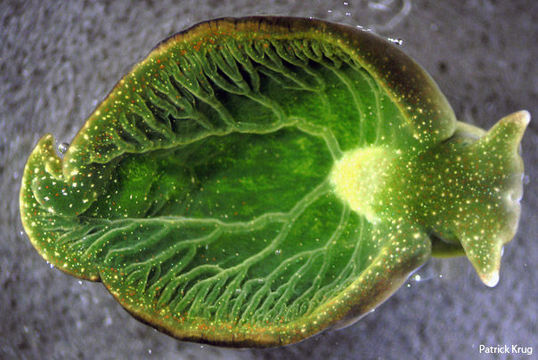
Green sea slugs get their vibrant emerald green colour from the algae that they eat, specifically from the chloroplasts contained within the algae. Chloroplasts are specialized compartments in plant cells that house all of the machinery required for photosynthesis. Think of them as little solar panels, converting sunlight into the energy plants need to grow. Green sea slugs are able to extract chloroplasts from algae and store them in special cells along their digestive tract. In some cases, chloroplasts are stored for more than nine months! For a long time, scientists believed that the main role of these chloroplasts was to generate energy for their new slug hosts by photosynthesis. This finding generated a lot of hype and understandably so. Green sea slugs are one of a small handful of animal species that can photosynthesize and quickly became known as “solar-powered slugs” and “leaves that crawl”.

The green sea slug Elysia chlorotica (Source)

In 2014, the idea that green sea slugs use their chloroplasts exclusively to generate energy through photosynthesis was challenged when a group of researchers found that blocking photosynthesis had no effect on weight loss or survival rate of green sea slugs during starvation. If the main purpose of chloroplasts was to generate energy for the slugs during starvation, then blocking photosynthesis should lead to lower survival and more weight loss. Based on these new findings, the researchers proposed a new theory for why green sea slugs hoard so many chloroplasts. Instead of using them as solar panels to create energy, the sea slugs are breaking down the chloroplasts into its many components and eating those parts as food. Maybe green sea slugs store chloroplasts for the same reason that bears store fat and squirrels store nuts before winter hibernation. This is not to say that green sea slugs don’t photosynthesize. They are undoubtedly capable of photosynthesizing and may use it to some extent to survive periods of starvation but just how significant of a contribution that is remains to be seen. Continue reading

Integrating self-collecting HPV DNA testing with community health worker programs increases cervical screening coverage

This past weekend, I attended a conference on health and high politics examining the role of politics, global partnerships, and innovation in health equity and security. Two talks at the end of the day stood out for me. The first was by Dr. Leslie Davidson, a professor of epidemiology and pediatrics at Columbia University, and the second was by Dr. Ophira Ginsburg, a medical oncologist at Women’s College Research Institute in Toronto who specializes in women’s health equity and global cancer control.

A common thread in both talks was the increasingly important role of community health workers in meeting the challenges of delivering health services to underserved populations. During Dr. Davidson’s talk, she mentioned a recently published study from Argentina demonstrating the effectiveness of using community health workers as part of an integrative program to promote cervical cancer screening. Ever intrigued, I decided to read the original paper and share it here.

In the study published in Lancet Global Health, researchers found that when community health workers offered self-collecting HPV tests to women, participation rates increased four-fold. Human papillomavirus, or HPV, DNA testing is emerging as a viable alternative to Pap smears in low-resource settings. Earlier studies have shown that HPV DNA testing is as sensitive as conventional Pap smears in detecting cervical disease. An additional benefit of HPV DNA testing is the potential for self-sampling, which allows women to collect their own vaginal swabs in the comfort of their own homes. Continue reading